

- You are here:
-
Home

-
News & Events
-
Events Calendar
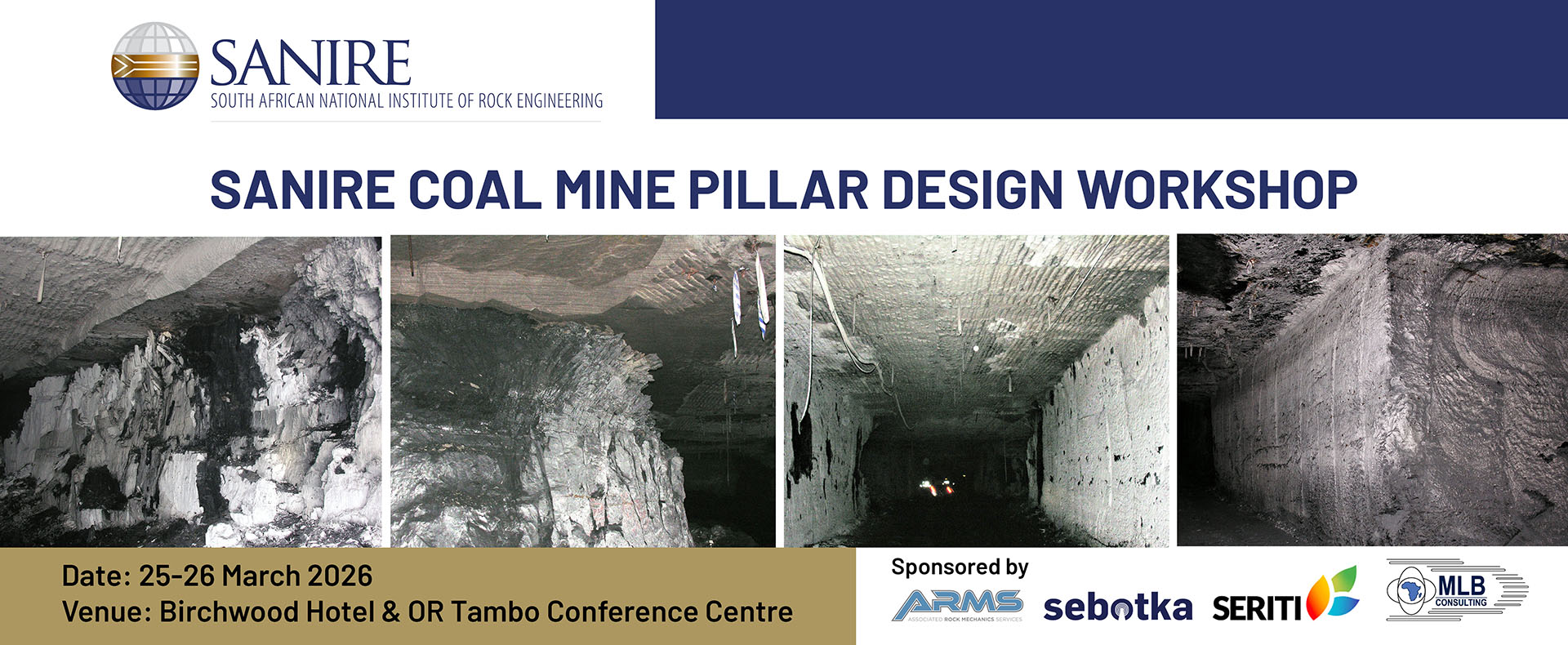
- SANIRE Coal Mine Pillar Design Workshop


To Thursday 26 March 2026
 |
 |
 |
 |
 |
 |
 |
 |
 |
 |
 |
 |
 |
 |
 |
 |
 |
SPEAKER
 Professor Nielen van der Merwe
Professor Nielen van der Merwe has been in the mining industry for 50 years, with 27 years directly in practice and 23 years in a combination of research and practice as a consultant. He is the author of two books and 90 other publications. He has been awarded the SAIMM Gold Medal for 4 papers and Silver Medal once and the Salamon Award twice. He was Head of the Mining Engineering Department of the University of Pretoria and incumbent of the Centennial Chair for Rock Engineering at the University of the Witwatersrand.
His leadership qualities are demonstrated by the fact that he was the last President of the South African National Group on Rock Mechanics (SANGORM) and following reconstruction, the first of the South African National Institute of Rock Engineering (SANIRE). In this capacity, he served as the Vice President for Africa of the International Society of Rock Mechanics (ISRM).
He continued promoting South Africa on the international rock stability landscape by becoming President of the ISRM (the first from Africa), and then President of the Federation of International Geo-Engineering Societies FeDIGS). He has been awarded Fellowship of the ISRM and is Fellow of the South African Academy of Engineering.
He was Head of Mining Engineering at the University of Pretoria and until recently he was a Visiting Professor at the School of Mining Engineering at the University of the Witwatersrand. To him, the most interesting part of rock engineering is to move beyond the simple concept of a safety factor, and rather base designs around the concept of time related failure probability. He currently operates in consultancy on a limited scale.
On a personal note, it is almost as if Prof Nielen was destined for a career in rock Engineering, with minimum input from himself. He was born in the mining village of the Durnacol mine (Dannhauser). Then his paternal grandfather was killed in a FOR (Fall Of Rock) accident followed by serious injury in another FOR to his new grandfather. One of his friends was killed in a FOR on a gold mine and another suffered life-changing injury. He enrolled as a mining student because they offered the best bursaries and decided to concentrate on rock engineering because it fascinated him. It was only after his decision to study rock engineering that he became aware of this mining background driven by fate.
WHO SHOULD ATTEND
Companies interested in sponsoring this event are kindly requested to contact us for more information.
Prudence Ntumelang: Administrator
Email: prudence@sanire.co.za
Tel: (011) 538 0241
Website: www.sanire.co.za
+ 27 (0) 11 538 0231 | Email us